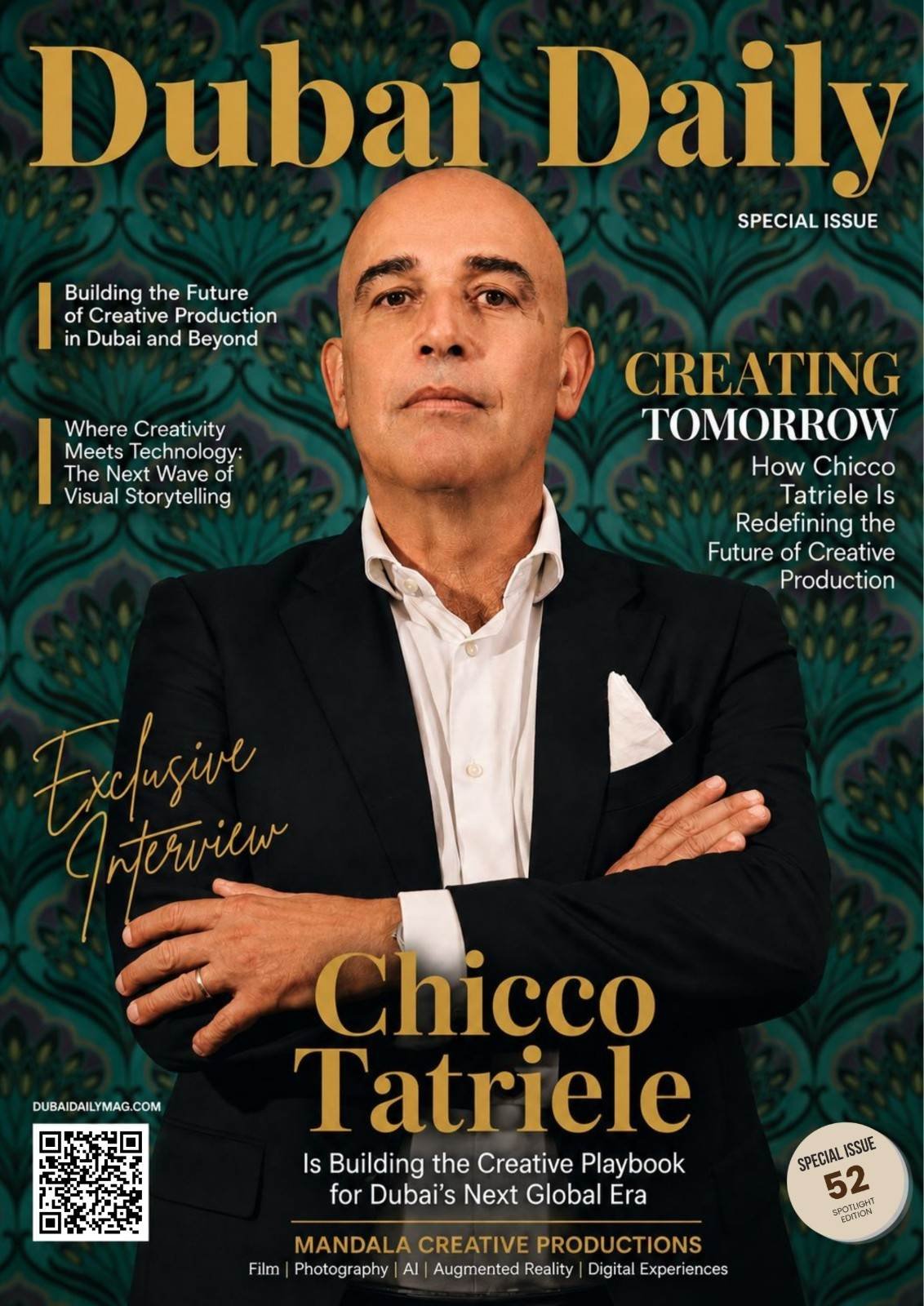
Chicco Tatriele Is Building the Creative Playbook for Dubai’s Next Global Era
Where technology, imagination, and strategic production converge to shape the visual language of Dubai’s next global creative chapter.
Dubai has never been a city particularly interested in standing still. Its defining instinct is acceleration—to take an idea that appears five years early and turn it into reality before the rest of the world has decided whether it is possible.
That makes it an unusually fitting market for Chicco Tatriele.
The Creative Executive Producer at Mandala Creative Productions is building his next chapter in a city where creativity is increasingly treated not as decoration, but as infrastructure. From luxury and hospitality to technology, real estate, culture and destination marketing, Dubai has become a marketplace where the quality of an idea can be as consequential as the product behind it.
Chicco Tatriele understands that shift.
His work sits at an increasingly important intersection: the discipline of traditional visual production and the possibilities being created by artificial intelligence, augmented reality and digital media. But his proposition is not simply that new technology can make better images. It is that technology is changing the very definition of what a production can be.
That distinction puts him in a more interesting position than the conventional producer.
The old production model was relatively straightforward. A brand had a campaign, a production team executed it, and the resulting film or photographs were distributed through established channels. Today's audience moves differently. A single creative idea can exist simultaneously as a film, a social campaign, an immersive installation, an interactive experience and an AI-enhanced visual environment.
The production leader of the future therefore needs to think beyond the frame.
That is the space Tatriele is increasingly occupying.
Through Mandala Creative Productions, he has helped develop an international creative model that brings together photography, filmmaking, digital art, sound and emerging technologies. The company's expansion into Dubai Media City gives that model a strategic base in one of the world's most connected creative markets.
Tatriele’s regional vision also extends through his partnership with EyeJack, where he serves as Growth Strategist with exclusive rights across the UAE and GCC. Through this role, he is helping bring EyeJack’s augmented-reality capabilities to brands, artists and experiences across the region.
Dubai gives ambitious creative businesses something arguably more valuable than geography: access to a culture that rewards experimentation. Global luxury houses, hospitality groups, property developers, cultural organisations and technology companies are competing for attention in a market where visual ambition has become part of the business strategy.
The result is a new creative arms race.
For Tatriele, that is precisely where the opportunity lies.
Rather than treating photography, film, AI and augmented reality as independent capabilities, his approach is to consider them parts of the same creative language. The technology changes according to the idea. The idea does not change simply to accommodate the technology.
That philosophy becomes especially relevant as artificial intelligence enters mainstream creative production.
AI has already transformed the speed at which concepts can be explored. Images that once required extensive planning can now be visualised in minutes. Entire environments can be prototyped before a camera is switched on. Yet speed alone does not create distinction. When everyone has access to the same tools, taste becomes more valuable.
Tatriele's opportunity is therefore not to become an advocate for technology for technology's sake. It is to become an editor of possibilities—to determine which emerging tools deserve a place in a story and which simply create noise.
That is a fundamentally different creative role.
The same thinking applies to augmented reality. In a region increasingly defined by experiential retail, ambitious architecture, tourism and large-scale cultural events, AR can turn an audience into an active participant. A campaign no longer has to end when someone stops watching. It can continue in the physical world around them.
Mandala's experience in immersive production points toward this wider ambition. Its work has extended beyond conventional campaign production into AR-driven experiences, including activations associated with SneakerCon Doha. The significance is not the technology itself; it is the underlying model—using digital interaction to give physical experiences another layer of meaning.
This is also where Tatriele's international perspective becomes an advantage.
The GCC does not need creative businesses that simply reproduce work created elsewhere. It increasingly needs partners capable of translating global standards into regional ambition. The best work must feel international without becoming culturally anonymous.
That requires a particular kind of producer: commercially aware enough to understand a client's objective, creatively ambitious enough to challenge the brief and operationally disciplined enough to turn an unconventional idea into something real.
Tatriele's career is increasingly defined by that intersection.
Mandala's Dubai expansion is consequently more than the opening of another production base. It is a bet on where the creative economy is heading. And it reflects a broader conviction: that the most valuable production companies of the next decade will not be defined by the equipment they own or the number of services listed on a website, but by the ideas they are capable of bringing to life.
That may be the most compelling part of Tatriele's story.
He is not positioning himself simply as a producer operating in a growing market. He is positioning production itself as a strategic creative discipline.
In Dubai, where entire industries are being redesigned around experience, technology and perception, that distinction could prove significant.
The future of creative production will not belong exclusively to filmmakers, photographers or technologists. It will belong to the people capable of making those disciplines work together without losing the human instinct that makes an idea matter.
Chicco Tatriele is building toward that role.
And if Dubai's next decade is as ambitious as its last, it may prove to be exactly the right place to do it.